
RESEARCH HIGHLIGHTS

10

NYCU

National-Level
Research Center

date from 2025

39

NYCU

University-Level
Research Centers

date from 2025

37

NYCU

College-Level
Research Centers

date from 2025

211

NYCU

Total Awarded Students
Participating in Competitions

Academic Year 2024–2025

299

NYCU

Number of Academic Papers
Published by Students or Exhibition
Activities Organized by Students

Academic Year 2024–2025

48

NYCU

Number of International
Collaborations on Academic
Research Projects

Academic Year 2024–2025

464

NYCU

Number of Students Attending
International Conference

Academic Year 2024–2025

  • Update Date:2026-09-16
  • Units:Communication and Outreach
NYCU Study Uncovers Signs of Natural Selection Shaping Disease Susceptibility in Taiwan
The study was featured on the cover of Nano Letters.
Genes reveal how natural selection shapes disease risk.
 
Edited by Chance Lai
______
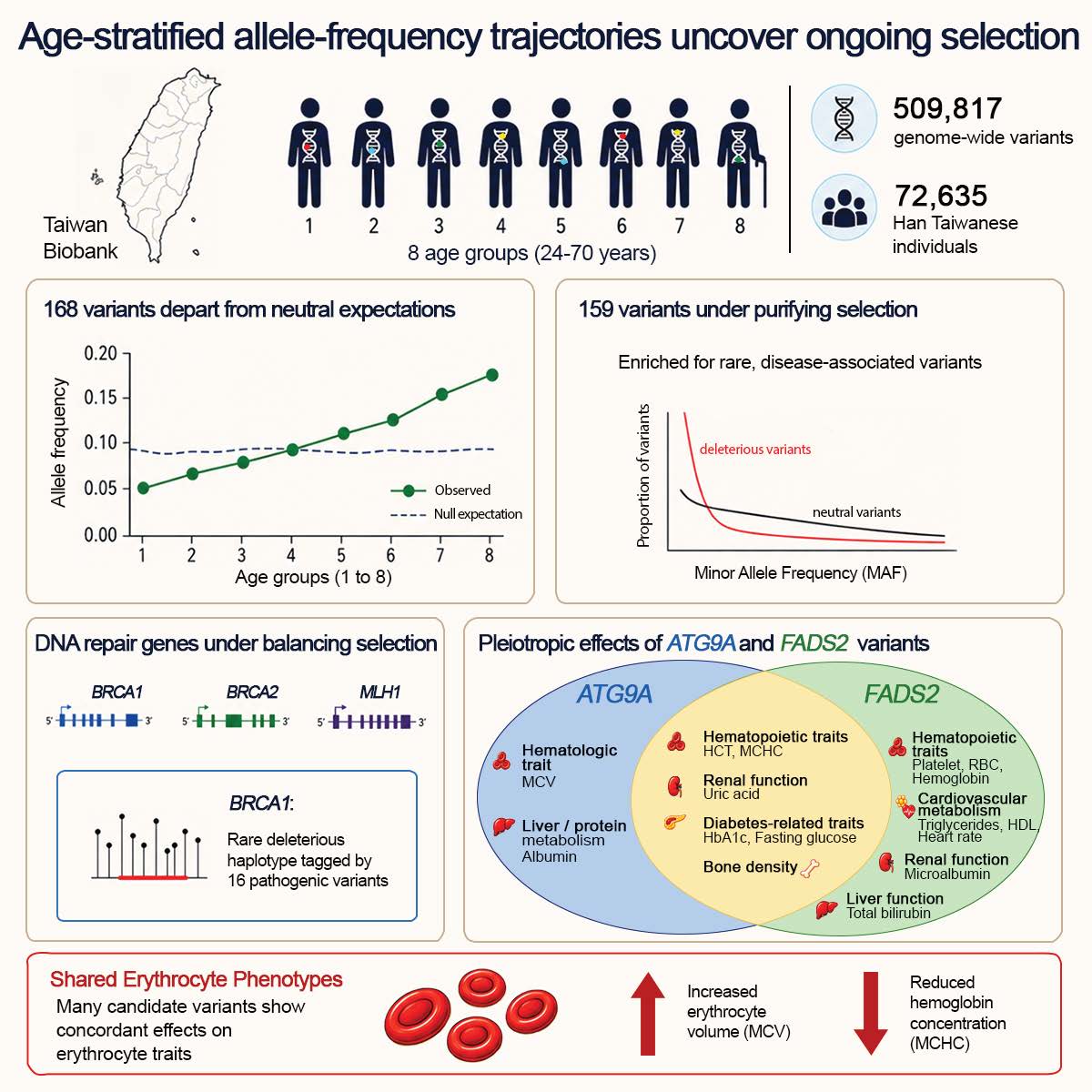
Scientists at National Yang Ming Chiao Tung University (NYCU) have found evidence that natural selection continues to shape genetic susceptibility to disease among Han Taiwanese, with the strongest signals involving red blood cell traits. The findings suggest that infectious diseases, including malaria, may have left a genetic legacy that remains detectable in Taiwan’s population today.

Led by Wen-Ya Ko, an associate professor in NYCU’s Department of Life Sciences and Institute of Genome Sciences, the researchers analyzed genetic data from 72,635 Han Taiwanese participants in the Taiwan Biobank. The study was conducted in collaboration with Professor Yoko Satta’s team at SOKENDAI, The Graduate University for Advanced Studies, in Japan.

By comparing the frequencies of genetic variants across age groups, the team identified 168 variants showing signs of possible ongoing natural selection.
 
Wan-Tzu Kuo (left), a graduate student at NYCU's Institute of Photonics, and Associate Professor Yao-Wei Huang (right) of the Institute of Photonics.
The research team analyzed genetic data from more than 70,000 Taiwan Biobank participants, identifying multiple genetic variants showing signs of ongoing natural selection.

A Striking Pattern in Red Blood Cells

Of those variants, 159 were less common in younger age groups — a pattern consistent with purifying selection, the process through which harmful genetic variants become less common over generations.

The findings were particularly consistent for red blood cell traits. The researchers identified 149 variants that were less common among younger participants and were associated with larger red blood cell volume and lower hemoglobin concentrations. The only red blood cell–associated variant that was more common in younger participants showed the opposite pattern: smaller red blood cell volume and higher hemoglobin concentrations.


Together, these findings suggest that natural selection may be reducing the frequency of variants associated with larger red blood cells.

A Possible Legacy of Malaria

One possible explanation lies in Taiwan’s history of infectious disease. Malaria was once endemic in Taiwan, which received certification for malaria elimination in 1965. Throughout human evolution, malaria and other infectious diseases may have exerted strong selective pressure on red blood cell traits. Taiwan Centers for Disease Control

The researchers suggest that the patterns they observed may partly reflect the legacy of those past disease pressures. As infectious disease exposure and living conditions change, genetic variants may face different selective pressures.

The possible connection to malaria remains a hypothesis, rather than a demonstrated cause of the patterns identified in the study.

Clues to Cancer Risk and Precision Medicine

The team also found signs of natural selection in BRCA1, BRCA2 and MLH1, genes involved in DNA repair and cancer susceptibility. In BRCA1, the researchers identified a rare haplotype — a group of genetic variants inherited together — carrying multiple disease-causing variants. This haplotype was less common in younger age groups.

Such rare, population-specific variants provide important genetic information for assessing disease risk and advancing precision medicine. For Ko, the findings highlight how comparisons across age groups can offer a window into evolution as it unfolds.

Natural selection is not confined to humanity’s distant past, he said. Its effects remain evident in contemporary populations, offering a new perspective on the relationship among human evolution, health, and disease.

Members of the research team.First author Jing-Lian Chen (second from left) with Professor Wen-Ya Ko (far right), members of his research team, and Professor Yoko Satta (second from right)
文/可文亞、公關組   圖/可文亞
科學家從超過7萬名臺灣漢人的基因資料中發現自然選擇的證據,特別是影響與疾病及紅血球性狀相關的遺傳變異,影響了現代臺灣人的疾病易感性。研究團隊推測,這些基因變異所呈現的自然選擇痕跡,可能與臺灣過去包括瘧疾在內的傳染病壓力有關。

生命科學系暨基因體科學研究所可文亞副教授帶領研究團隊,與日本綜合研究大學院大學(The Graduate University for Advanced Studies, SOKENDAI)颯田葉子(Yoko Satta)教授團隊合作,利用臺灣人體生物資料庫(Taiwan Biobank),分析72,635名臺灣漢人的基因資料,比較不同年齡族群的基因變異頻率,辨識出168個可能正受到自然選擇影響的基因變異。

在這些基因中,有159個基因隨著世代逐漸減少或消失(註一)。其中紅血球性狀尤其呈現出一致的訊號。研究發現,149個在年輕族群中逐漸減少的變異,都與較大的紅血球體積,並伴隨較低的血紅素濃度相關;唯一在年輕族群中逐漸增加的變異,則呈現完全相反的影響。這種高度一致的模式顯示,自然選擇可能正逐漸降低與較大紅血球體積相關的遺傳變異。


這樣的自然選擇可能與瘧疾假說有關。臺灣直到約60年前仍是瘧疾流行地區,而瘧疾等傳染病在人類演化歷史中可能對紅血球性狀形成強烈的選擇壓力。研究團隊推測,這些紅血球相關訊號可能部分反映過去疾病環境所留下的影響;隨著疾病與生活環境改變,遺傳變異也可能面臨不同的選擇壓力。

此外,研究在BRCA1、BRCA2與MLH1等DNA修復及癌症相關基因中,研究團隊也發現自然選擇的痕跡。其中,BRCA1發現一個帶有多個致病性變異的罕見單倍型,在較年輕族群中的頻率逐漸下降。這類族群特有的罕見致病變異,是疾病風險評估與精準醫療的重要遺傳資訊。

可文亞表示,從現代不同年齡族群的基因變異頻率中,觀察自然選擇持續作用的痕跡,顯示自然選擇並不只存在於遙遠的人類演化歷史,而是至今仍持續塑造疾病易感性,為理解人類演化、健康與疾病之間的關係提供新的研究視角。

註一:專有名詞為淨化選擇(purifying selection)。指對於物種生存不利的基因變異,會隨著世代逐漸減少。
 

Related Image(s):