RESEARCH HIGHLIGHTS

10

NYCU

National-Level
Research Center

date from 2025

39

NYCU

University-Level
Research Centers

date from 2025

37

NYCU

College-Level
Research Centers

date from 2025

211

NYCU

Total Awarded Students
Participating in Competitions

Academic Year 2024–2025

299

NYCU

Number of Academic Papers
Published by Students or Exhibition
Activities Organized by Students

Academic Year 2024–2025

48

NYCU

Number of International
Collaborations on Academic
Research Projects

Academic Year 2024–2025

464

NYCU

Number of Students Attending
International Conference

Academic Year 2024–2025

  • Update Date:2026-10-01
  • Units:Communication and Outreach
Evolution’s “Copy and Paste”: NYCU Study Reveals How Proteins Build Function Through Repetition
NYCU brings campus exploration online through Minecraft and 360-degree virtual tours, with AR navigation extending the experience for in-person visitors.
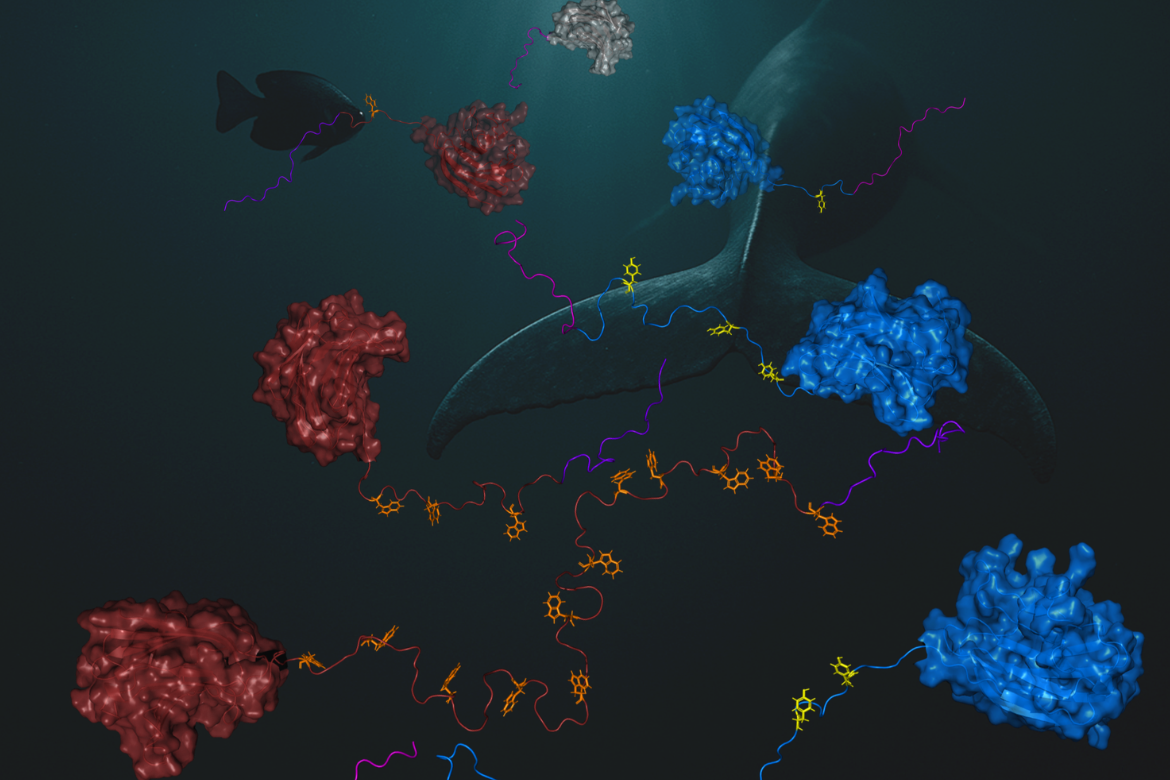
Despite differences in their aromatic amino acids, the intrinsically disordered regions of human and zebrafish galectins both support molecular clustering. (AI-generated illustration
 

______
“Copy and paste” may be a familiar computer shortcut, but a study from National Yang Ming Chiao Tung University (NYCU) suggests that protein evolution can follow a similar pattern: repeating useful segments to build stronger biological functions.

Led by Professor Jie-Rong Huang of NYCU’s Institute of Biochemistry and Molecular Biology, the research examines flexible regions of sugar-binding proteins called galectins. The findings suggest that increasing the number of repeated segments can play a greater role in bringing molecules together than fine-tuning the specific amino acids within those segments.

Published in EMBO Reports, the study, titled “Evolution of Intrinsically Disordered Regions in Vertebrate Galectins for Phase Separation,” offers insight into how proteins in different vertebrate lineages evolved similar functions despite differences in their molecular building blocks.
 
NYCU’s “360° Campus × Minecraft” event connects virtual campus tours with a Minecraft treasure hunt. From September 2 to 15, 2026, participants can complete tasks across both platforms and register with their NYCU email address for a chance to win prizes.
An AI-generated illustration depicts the convergent evolution of intrinsically disordered regions in vertebrate galectins, showing how repeated molecular segments can give rise to similar functions across species.

Different Ingredients, Similar Results

Proteins are often associated with precise, folded structures. But many also contain intrinsically disordered regions—flexible stretches that do not adopt a single stable shape.

Huang’s team investigated these regions in vertebrate galectins, including human galectin-3. Their interactions help proteins gather into concentrated assemblies through a process known as phase separation, enabling them to cluster sugar-bearing molecules. Galectins participate in biological processes, including immune responses and cell communication.

Earlier studies using short peptides had emphasized the importance of particular aromatic amino acids, suggesting that the identity of these molecular “sticky points” strongly influences assembly.

Yet comparisons across species revealed different ingredients capable of supporting a similar function. Human galectin-3 contains repeated segments rich in tyrosine, while the zebrafish galectin examined by the team predominantly uses tryptophan. Both can promote molecular clustering. That raised a question: How could proteins with different components arrive at a similar result?


Building Strength Through Repetition

The team’s experiments pointed to the number of repeated segments as a major factor. Increasing those repeats strengthened the protein’s capacity to assemble and drive clustering more substantially than changing the type of aromatic amino acid. The finding suggests that repetition can provide an effective evolutionary route to stronger function, without requiring the same molecular ingredients in every species.

Huang likened the process to the computer commands “Ctrl+C” and “Ctrl+V.” Starting with a short, useful sequence, successive duplications can expand the number of interacting segments, allowing their combined effects to build.

The researchers propose that different vertebrate lineages independently expanded these segments, converging on similar clustering functions. In this model, evolution builds on existing modules, with further changes adapting them to each species’ needs.

The conclusion is not that amino acid identity is irrelevant. Rather, the study identifies repeat number as a more influential factor in the galectins examined, challenging an explanation centered primarily on the choice of individual aromatic amino acids.

New Possibilities for Protein Engineering

The findings offer a potential design principle for protein engineering and synthetic biology: adjusting the number of functional modules could help researchers tune how proteins assemble.

Such an approach could inform the development of biomedical materials with specific phase-separation properties. It may also guide future investigations into molecular mechanisms associated with abnormal protein condensation.

Those applications remain possibilities for further research. The study’s immediate contribution is a clearer picture of how flexible protein regions can acquire function through repetition—a molecular version of building on what already works.

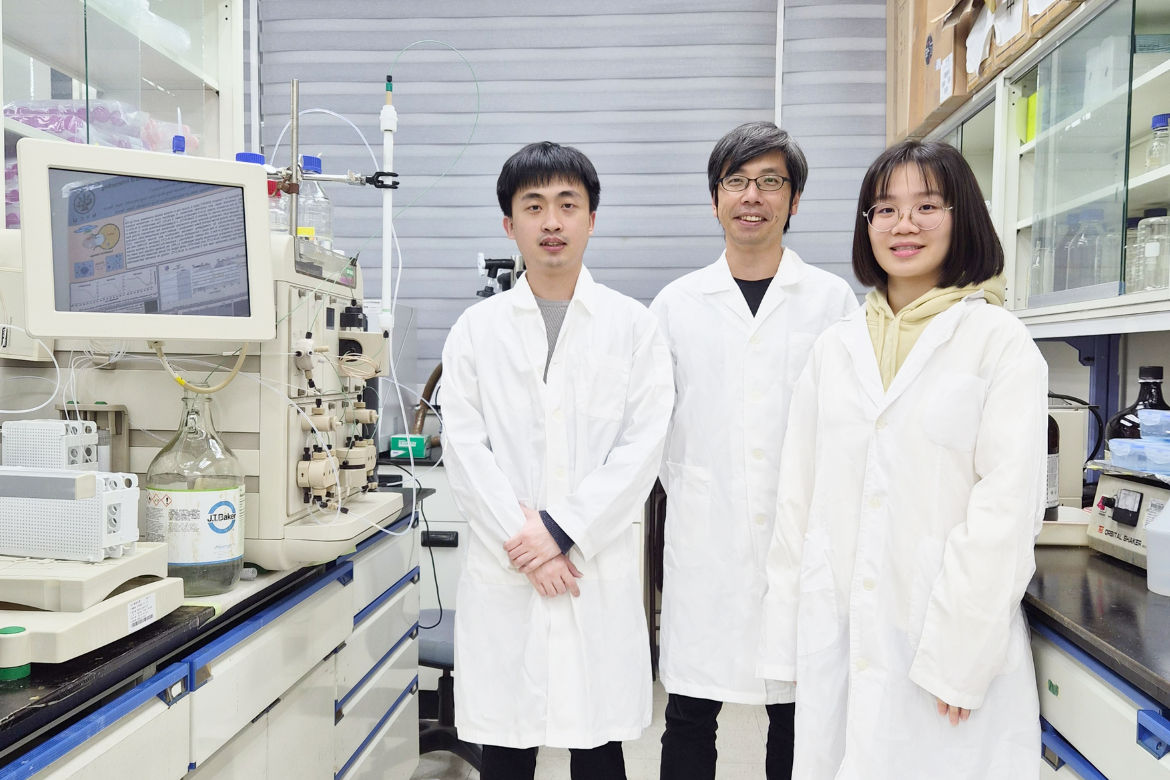
AR Takes the Experience Onto CampusThe research team, from left: doctoral student Yu-Hao Lin, Professor Jie-Rong Huang and master’s student Yu-Chen Chen.
文/公關組 圖/研究團隊、公關組

複製(Ctrl+C)貼上(Ctrl+V)是電腦文書處理最常使用的功能。令人意外的是,科學家發現蛋白質演化的時候,竟然也採用類似的高效率策略。

陽明交大生化暨分子生物研究所黃介嶸教授研究團隊,最近針對脊椎動物體內一段沒有結構的蛋白質區段進行研究,發現這類蛋白質的功能演化,並不一定是靠精雕細琢調整每個化學零件,而是透過不斷「複製貼上」特定片段,逐步累積出越來越完整的功能。

黃介嶸研究半乳糖凝集素這段沒有結構的蛋白,會聚集成像小水滴般的液滴,進而把細胞內的醣分子黏在一起,在身體免疫與細胞溝通中扮演關鍵角色。

過去科學家常認為,這種聚集能力高度依賴特定種類的胺基酸,就像黏膠必須使用特定成分,才能提供足夠的黏合力。然而研究團隊比較大量生物資料的半乳糖凝集素後發現,不同生物使用的「材料」其實很不一樣。例如人類的蛋白質較常出現酪胺酸,斑馬魚則較常使用色胺酸,但兩者都能成功發揮凝集的功能。


既然材料不同,為什麼功能可以殊途同歸?研究團隊實驗發現,真正重要的不是一定要使用哪一種胺基酸,而是取決於材料重複的數量。黃介嶸形容,演化傾向於在蛋白質序列中不斷「複製貼上」相同的氨基酸的片段。

換句話說,演化並沒有執著於在單一胺基酸的強度上鑽牛角尖,而是採取了更簡單有效率的「以量取勝」策略,只要把能發揮作用的小片段重複排列,就能累積出足夠的凝集能力。

黃介嶸說,面對生物複雜的生理需求,蛋白質從一個短小的序列出發,直接利用宛如電腦指令「Ctrl+C / Ctrl+V」的複製貼上機制,不斷疊加這些模組序列。透過單純增加模組重複的次數,不同物種最終都能獨立趨同演化出強大的凝集功能。這種靈活的擴增策略,完美展現了大自然在分子層次上的模組化設計智慧。

這項刊登在《EMBO Reports》的研究,打破了以往認為蛋白質功能必須精準設計的觀點,替未來蛋白質工程與合成生物學提供新的想像。若科學家能借鏡這套大自然的程式碼,未來或許可設計出具有特定相分離特性的生醫高分子材料,或是針對異常相分離引起的疾病尋找新的標靶機制。
 

Related Image(s):